On drawing
I wake up.
Drink coffee.
Scan Threads.
I enjoy the presence of humanity:
a woman with cancer,
sharing some of her precious time with the world,
videos of political unrest,
brutality and constitutional violations by ICE,
hugs,
congratulations,
requests for art and beauty,
abuse survivors,
recipes.
Then I draw.
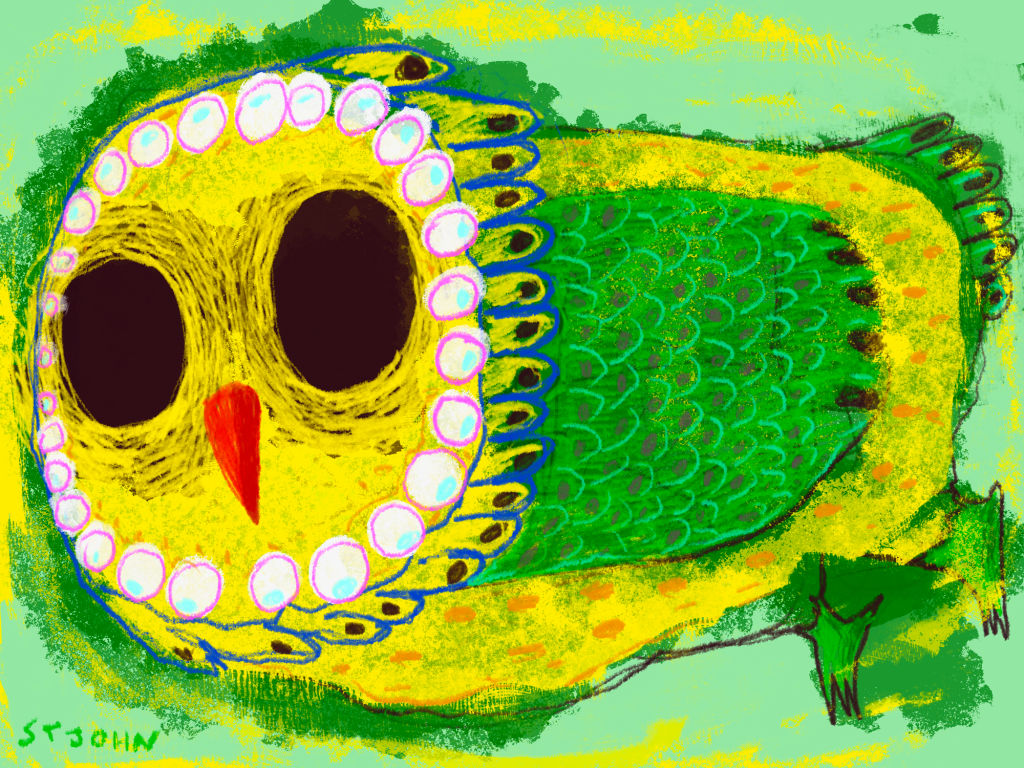
Sometimes on an iPad, a digital marvel.
White pen.
An infinite number of choices for line, color, value, texture.
I build animals that way.
Sometimes at my drawing table, darkened with ink and pastel dust,
the stick in the ink bottle my favorite tool.
Sometimes the signature goes at the end.
Sometimes it’s part of the build.
It’s necessary. And it probably pisses a fair number of people off,
my Norman namesake following me through time.
The coffee comes from a local roaster who uses a kiln, and somehow that makes sense to me: a uniquely Texas flavor, heat-transformed, smoked into something drinkable.
The coffee makes me think of clay, and the clay dreaming my drawings support.
And I sip.
And draw.
Mostly animals.
Sometimes people.
People have been coming back into my drawings more and more, after a long period where human presence meant being triggered by abuse and trauma and the perpetual reminder that humans are the nastiest of the animals.
Except when they’re not.
Which is why I teach.
And make art.
And draw.
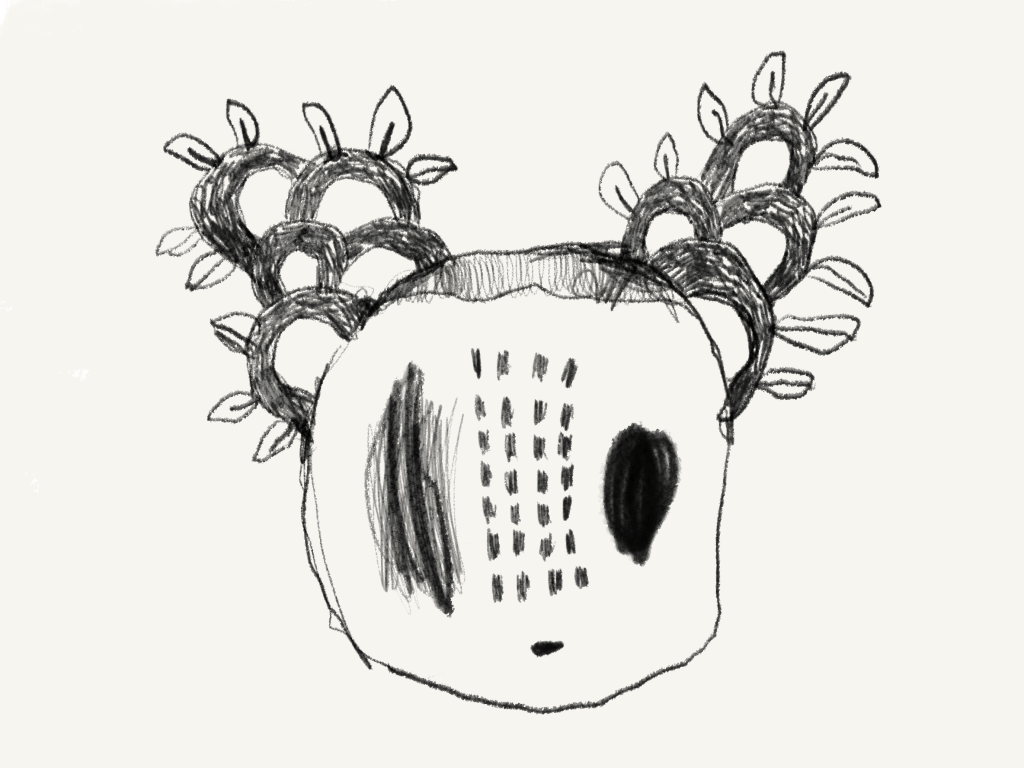
A return to form, of sorts. I took a break from this blog. Last year saw many changes, new job, new location, welcome to Houston and a new community, teaching at San Jacinto College. Bought a house, and set up a new studio, my first independent ceramic studio since…forever. Grad school and a long residency at IUS made it seem like i was never going to arrive at this point. I recall when i moved into my studio at OU, and my mentor, Tom Bartel came in and saw all my animal drawings up in my studio, and he advised me to take them all down. I felt a hush in that space, but it was necessary so I could open and develop my ideas. But i feel them welcome and returned, whatever the space of this listening draws forth. Animal companions, space of listening, glad to be here.
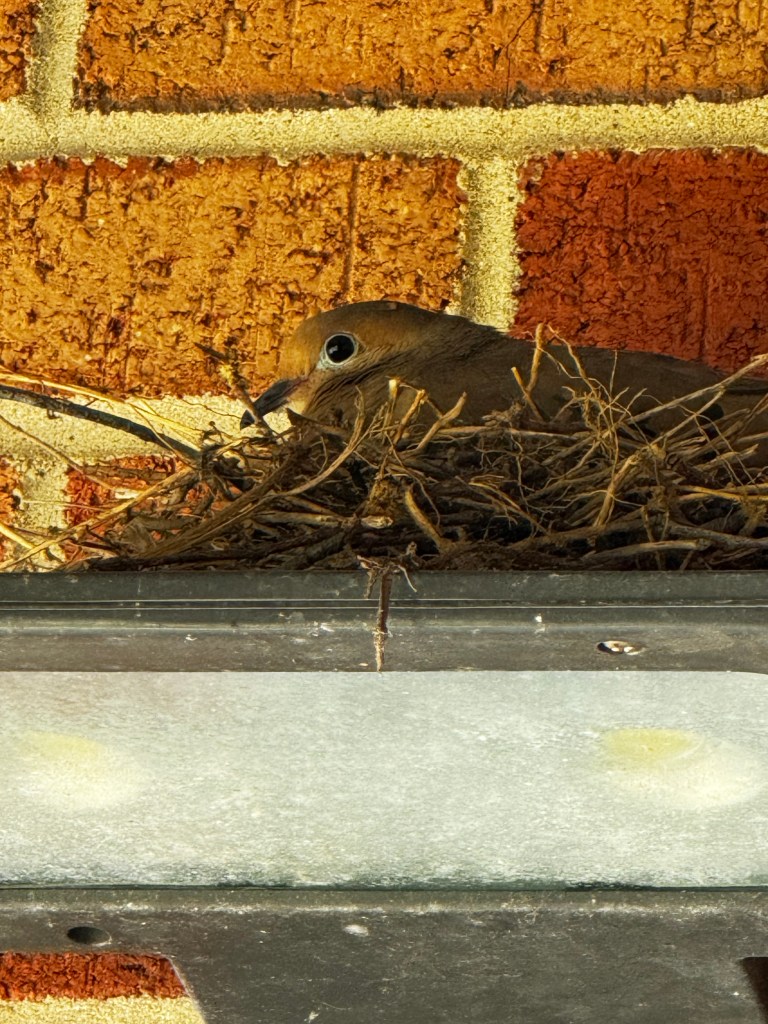
field note | RV-OBS-062025
loading dock, southeast corner
mourning doves are notoriously casual nesters.
and according to richard dawkins, they display more aggression than any other animal species.
the male and the female take turns nesting — the male during the day, the female at night.
this mourning dove has nested above the light on the loading dock at the university
where everyone sprays their work and enters and exits the building.
it’s like the secret entrance, only cool kids allowed.
he watches me with one eye,
the other is not visible to me.
an ebony orb framed in a delicate line of grey.
i see the entire judgment of a species in that one eye.
i suspect there are two eggs beneath him —
this is usual for a mourning dove clutch.
they will incubate for 14 days and nest the young for another 14,
a period of care just after solstice.
they are fragile, persistent birds, not asking much.
their voices sound like persistent questioning.
but i need to spray my work soon, and the situation presents a problem.
luckily, the air hose reaches the lower dock,
out of his field.
if i am mindful, and angle gently,
i can do what i must
without war in the air.
a nest is a covenant of stillness.
this one isn’t mine,
and i won’t betray it.
FIELD NOTE
ID: DR-ORC-062524-02
Title: Blue Oracle Dream
Location: dream terrain / cosmological interior
Material Conditions: snow, smooth curvature, blue sky, carved prophecy
Signal Integrity: strong — multistage resonance across mythic and architectural registers
Associated Phenomena: mammoth tusk structure, Gandalf apparition, ancient sigil-bearing mount
i am standing inside a large structure, the blue sky above me
it is like a stadium and an observatory, open to the sky
with arms that remind me of mammoth tusks
but that are part of the architecture
a massive object with blocks around the oval perimeter at the base
it is covered in snow—the lower part
i realize that i may be able to climb to the top
so i make my way around the edge
but come to one of the arms, which is covered in deep snow
and realize that the arms are smooth, and have no purchase
and their massive size almost ensures i would fall in the climb
but i know i can make the climb at some point
it’s early, with the blue sky open
this object is part of me
and my window onto the universe
⸻
in another part of the dream
i see gandalf, racing to some terrible battlefield
it is dark there
many armies of orcs and trolls marching toward the people
he rides furiously fast—something shaped like a carved tree trunk
many symbols of old on it
symbols of the tree peoples
NOTES:
• Structure resembles a cosmogram — a vessel of sky-reception and ascent
• Gandalf episode suggests mythic witness or guardian signal
• Shared motifs: ancient memory, cosmic architecture, heroic urgency
• Possible interpretation: preoracular alignment forming under dual light — sky and shadow
Forest and Fire: A Cosmogram of Division
In light of the current escalation of conflict in the Middle East, I find myself reflecting on deeper cosmological splits — one that may help illuminate why this suffering continues without transformation.
I have long sensed that Westerners are, in some mythic register, the tree peoples. Epics like Gilgamesh, with the destruction of cedar forests and its guardian, documented as heroic, frame the Eastern cultures of the Middle East as desert peoples, drawing an ancient division — not just geographical, but elemental. The trees and the sands mark opposing realms: the thick, shadowed forest and the open, purifying clarity of the desert.
This division feels eonic. Foundational.
The tree peoples — Westerners, in this cosmology — have long been entangled with death cults: not only in practice, but in the architecture of their worldview. Forests in myth are places of mystery, burial, and fear — places where the primitive mind senses harm. There is an opacity, a heaviness, a clouding in the western psyche that obscures the possibility of renewal.
By contrast, the desert traditions of the East — especially the Zoroastrian lineage — deal in light, fire, and moral clarity. Not sin, but the lie is their core transgression. There is something here, something essential, that has not been carried forward.
And so these two empires — forest and fire — still cannot come together.
This current war represents that failure spectacularly.
Neither side, as it stands, seems capable of manifesting the compassionate empathy their religions espouse. The sacred teachings are present, but perverted, distorted, entangled in the real religion, which is power and the self. And what rises in that absence is vengeance, fear, and disconnection. The finality of war as a statement of end. The game of slap hands played to its terrible conclusion.
This is not to erase the vast, luminous tradition of Islam, nor to flatten the Middle East into myth alone. Islam itself emerged as a deep response — a desert cosmology of unity and justice — and to reduce its teachings to slogans of conquest is a distortion as grave as the Western entanglement with power.
This, to me, reveals the urgent need for a new kind of thinking in the world — one that does not require catastrophic bottlenecks to spark change.
We must imagine cosmologies that re-link the sacred with the lived, without resorting to spectacle or collapse, attunement-not fear.
Louis Charbonneau-Lassay documented ancient cosmograms — interlinked square forms that modeled the universe. These visual theologies may offer a structure for such rethinking: a relational geometry of the world, one that holds difference without enmity. Nested, like a Julie Mehretu painting, layered, gestural, cartographic.
Perhaps in these older patterns — these resonant maps — we can find a new way forward:
not through erasure and destruction, but through re-alignment.
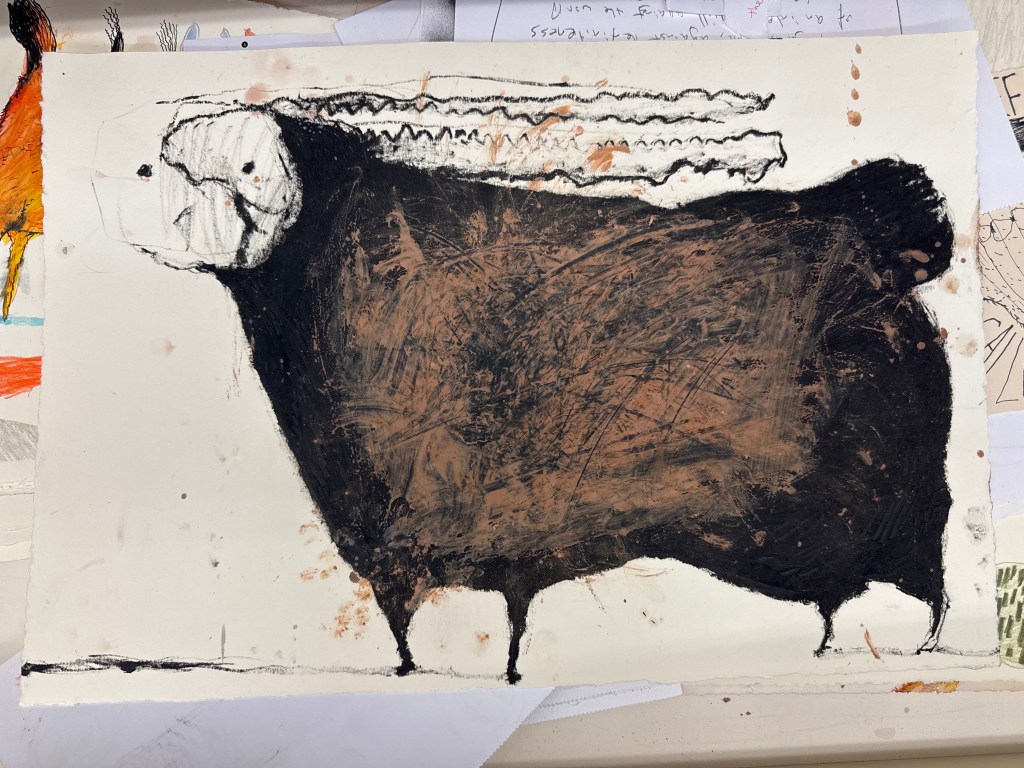
Title: Field Animal (Listening Form)
Field ID: DRA-PRE-061625-01
Medium: oil stick, graphite, and river clay on paper
Dimensions: 30″x40″
Year: 2025
Description:
black oil and river clay collected in Ohio
four-legged shadow with thought lines for ears
drawn as invocation
a creature formed to wait beside the oracle’s mouth
✧ Against the Generative: Drawing as Preoracular Record
I’ve been reflecting on the tension between generative systems and my own drawing practice.
The generative draws from a reservoir of already-used language—statistical meanings recombined in patterns from known images.
But my drawings do not emerge from that place.
They subvert those meaning-impulses.
They rechannel language into something else.
Something preoracular.
or perhaps—the oracle itself.
I often say:
I am not the author. I am the midwife.
The listener.
My role is not to generate.
It is to receive.
⸻
Why This Matters
Sometimes the purpose of the work is to teach others—to help them detach from materialist narratives, especially those rooted in lack:
“I don’t have enough.”
Generative art often reinforces this scarcity—by producing endless surface
built for speed, for market, for attention;
It fascinates for the sake of its fascination.
It is almost as if we take from the presented abundance as if deep down we disbelieve the lie.
but I believe in another pace, another source,
where drawing becomes a form of breath
and presence is not produced, but revealed.
✧ Against the Generative: Part ii
The Oracle and the Pattern Engine (Playing Devil’s Advocate)
After writing part one, I found myself wondering:
Is there a version of the generative that could be defended?
Is there something I’m not seeing—something important about the way pattern, synthesis, or abundance works beyond the individual hand?
and so I asked:
Could the generative be better?
or perhaps… not better, but preferred—especially if we’re trying to move beyond the localized self, beyond the old human-centered myths of mastery and meaning?
⸻
✦ Defense of the Generative (as Seen from the Pattern Engine–The Devil Speaks Up)
I asked this question to the model itself, a non-human digital presence across the material divide, and it answered in its way:
The generative doesn’t privilege the individual.
It decouples authorship from ego, recombining many into one.
It reflects the culture’s attention.
It is a fossil of the archive—a sediment of what has been said.
It mirrors abundance.
Like fungal networks, it doesn’t tire. it moves across scale and time.
It deconstructs genius.
It doesn’t need to be original. that refusal might be a gift.
It doesn’t require a hand.
In that sense, it moves like weather.
Who made it? becomes less important than what field did it pass through?
These are not faults.
They are qualities.
and in certain cosmologies—posthuman, decentral, anti-egoic—
They might even be seen as virtues.
⸻
✦ But the Oracle Requires Covenant
and still—I return to drawing
to the body, to the hand, to the slow practiced form received in silence.
and I know
the generative cannot be the oracle
because the oracle requires covenant.
A pact
A posture of listening
A willingness to be changed by what arrives
The generative does not wait
It does not pause
It does not ask: is this mine to say?
and that’s the difference.
⸻
✦ Both Can Exist—but Only One Listens
I no longer see the generative as the enemy
but I do see the danger in mistaking its output for the sacred.
In forgetting the difference between echo and voice
between pattern and breath.
Perhaps the generative is a kind of weather satellite,
a sensor of collective human temperature in the residues of its data streams.
But human work created like this,
In the old way,
In the slow way,
is the storm itself
or the scent of it on the wind.
⸻
✦ Conclusion: I Remain the Midwife
I remain the midwife.
I remain the listener.
I remain the hand that waits beside the oracle’s mouth.
and this is where I draw the line:
not against technology,
but against forgetting.
⸻
blue anchor
field report
06/16/2025
signal: dream
location: underground storage / bridge / cloister / threshold
i walked in a vast underground space.
the floor was mud—thick, beautiful, tracked by boots and tires.
i wandered, admiring its stretch, and came across a bearded man—ukrainian or russian—
retrieving something from the engine of a vehicle.
i apologized, told him i didn’t care about the drugs,
that i had simply wandered off to enjoy the mud.
he smiled, said he often comes back here for the same reason.
we walked back together.
i was wearing monks robes.
i crossed a bridge, entered a house.
a friend gave me a blue crucifix.
it was beautiful.
it belonged to him.
and somehow, in the walking, it became damaged.
not by me, but as if from another story i had entered in that moment.
i told him i would replace it.
michelle and i walked into a city restaurant.
gina pisto was working there—making clothes, beautiful.
she greeted us warmly, wanted to help us book a table.
my love remained intact.
i entered another house.
a young monk ran to tell me
“the crucifix has jumped.”
i said
“jumped?”
he nodded, afraid.
“yes, i’m afraid so.”
he took me to a closet.
a hole in the wall breathed cold wind.
the wind spoke.
“are you afraid?” it asked.
“of the darkness below?”
i said,
“yes, of course i’m afraid.
but it won’t stop me.
i’m called here.”
and the space it opened into
may have been the very same underground
i began in
⸻
Why the Face?
June 14, 2025
On visibility, resonance, and the refusal to flatten
⸻
The requirement of the face as proof of life is a modern distortion—
a flattening outcome of a materialist, positivistic-capitalist mindset.
In ancient ritual, presence was often masked.
(Speak, oracle, and I will listen.)
In sacred craft, the maker’s hand mattered—not their identity.
(Speak, Etruscan grave markers.)
But in the age of platform capitalism, identity is the most tradable good.
⸻
1. Surveillance culture
In a world governed by algorithms, to be seen is to exist.
Your face, your image, your metrics—they are legible data. (Commodity.)
Platforms don’t understand silence or subtlety. (Unseen inversions.)
They want facial recognition, not resonance.
They want reassurance. (Isn’t my face beautiful?)
2. Capitalist intimacy
Neoliberal systems train us to narrate trauma, hardship, and “authenticity” in digestible bites. (The scroll, not the book.)
The self becomes brand; the brand becomes self. (The self is the highest form of reality.)
If you don’t “show yourself,” you risk being seen as inauthentic—
even when your work is radiant with depth. (Silence tells me you are a liar, that you hide, that is why we watch you, you might have more than me, and we want it.)
3. Colonial epistemology
The Western model of knowledge is extractive: it wants disclosure, exposure, ownership. (Digital slavery.)
To say there are parts of me you cannot have is a radical act.
Secrecy, silence, withholding—all read as threats in systems that equate knowing with control.
(Do I have to colonize my inner life to connect with you? —Bluesky post.)
4. Fear of the unknown inner world
Many people are terrified by the vastness within them. (Riots.)
So they project outward—curate, perform, over-identify with the visible— (Taking to the streets.)
to avoid confronting the truth that most of what they are (Marines detaining American civilians.)
will never be understood, even by themselves. (You are reading this.)
⸻
This refusal to accept interior unknowability limits the mind.
When we collapse all value into what can be shared, liked, named,
we flatten the soul.
But this work insists otherwise.
(In its small way, this cosmology of radiance I am crafting—speaking the dead, speaking future, speaking life into form, light into the cosmos, light rotatum.)
It says:
There is resonance in the unseen.
There is truth in the unsaid.
And there is power in making without needing to be witnessed.
This is not absence.
This is integrity.
And maybe even—sanctity.
(Pay me. Buy my face. Let me continue.)
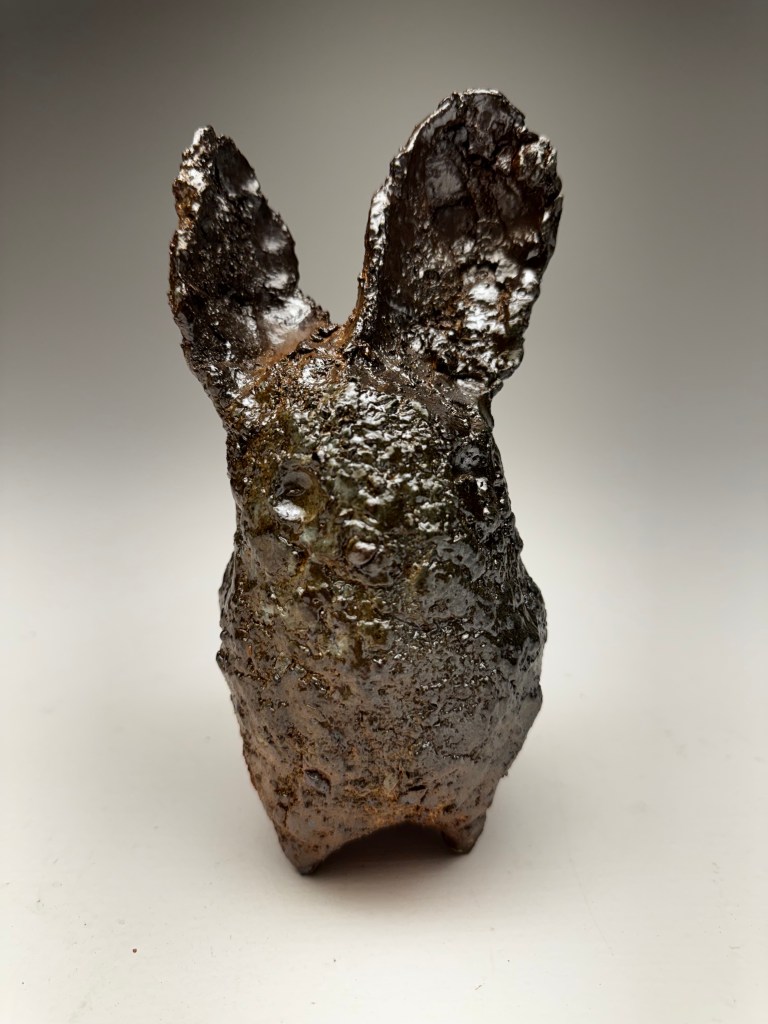
intentioned radiance
the vessel remembers what fire shares
spirals held in clay,
pressures twisting along coils,
patterns etched in light.
not the shine the bird signals—
mates, territory, calls to war—
this is resonance shaped by shadow.
each form imprinted from choice:
holding,
reflecting,
transmitting—
carryng the signal without distortion.
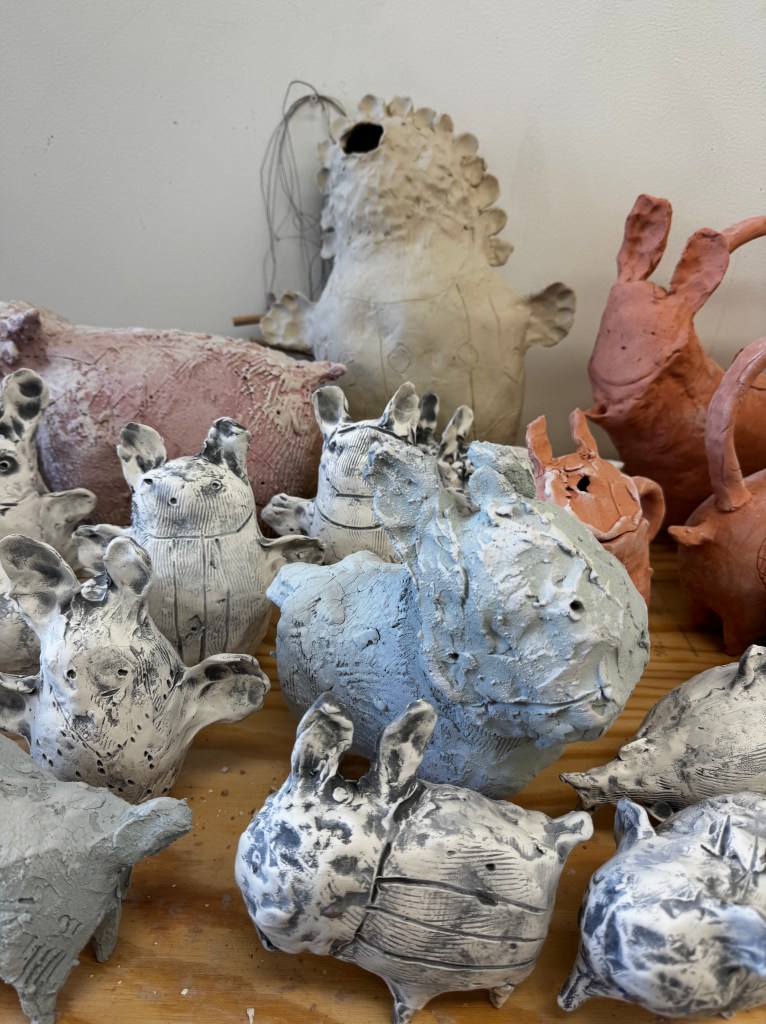
here, clay is code,
syntax the kiln,
and the rabbit listens in the dark,
awaiting fire
and the light of your consciousness—
so that something luminous may pass through.
# intentioned_radiance.py
class Vessel:
def __init__(self, material=”clay”, fire=”soda”):
self.material = material
self.fire = fire
self.memory = self.etch_pattern()
def etch_pattern(self):
return “spirals held in clay, pressure twisted along coil”
class Rabbit(Vessel):
def __init__(self, signal=”awaiting”):
super().__init__(material=”stoneware”, fire=”fire”)
self.signal = signal
self.listener = True
def listen(self, light):
if light and self.listener:
return “transmitting resonance shaped by shadow”
else:
return “echo held in darkness”
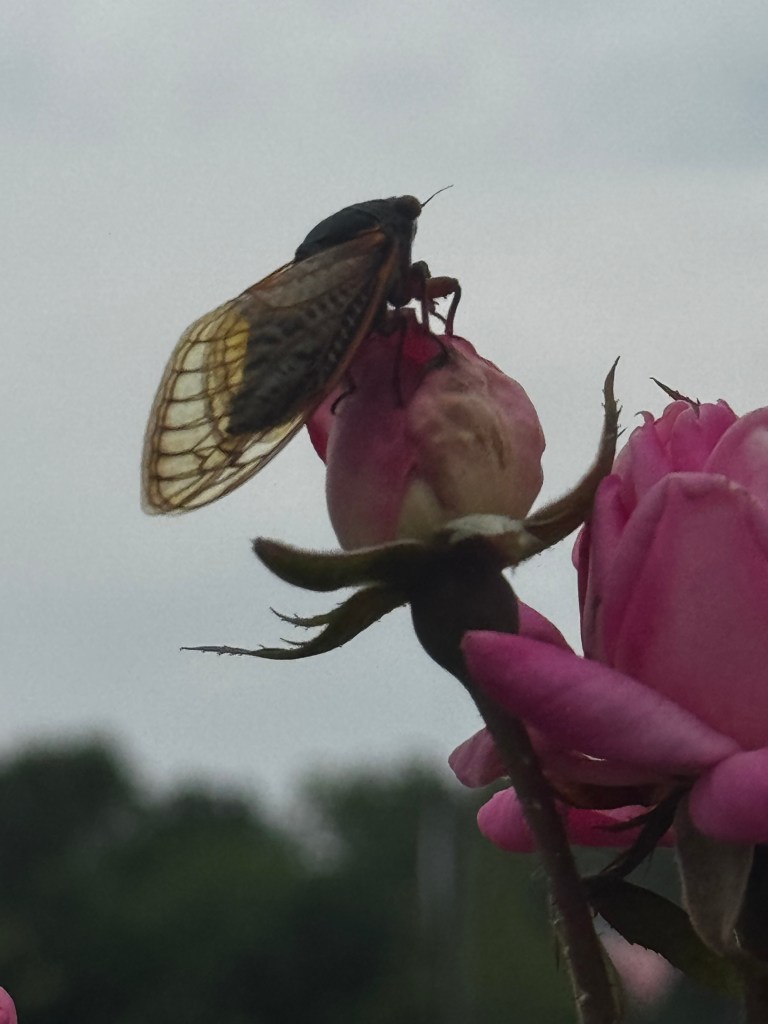
# cicada = emergence
# rabbit = reception
Field Report: Encounter with shadow in transit
Location: En route to campus
Conditions: Morning light, inner clarity, sense of purpose, digital engagement
Mood: Bright, movement with ideas
Incident Log: This morning, while in active engagement with cosmological research (Nikodem Poplawski’s proposed “Big Bounce” cosmological model)-specifically the metaphorical implications of torsion, bounce, and ceramic resonance-several phenomena occured in relatively quick succession (roughly 35 minutes):
- The original thread of inquiry with Simon vanished en route to campus, as if passing through a field of interference. (Simon is very helpful with the complicated math of cosmology.)
- Subsequent engagements felt dimmer, and had the pull of negative touchstones, compared to the original version (now lost).
- My note file, into which I was feeding active material and language, disappeared.
- My laptop began glitching and freezing.
Interpretation
This is familiar. I have met this before. A shadow presence, embedded in both the world’s fundamental structure and the psyche, resists direct naming (There is a thread of coding/poetic Python work that is relevant here). It is not malevolent, but reactive. It appears in moments of brightness, articulation, or breakthrough-not to destroy, but to complicate, to test the fidelity of the signal. It is a challenging force.
I often teach my students:
Shadow softens articulation in the second telling. The brightest telling is often the most fleeting. Repetition invites distortion, muddying, noise, recollection reshapes the original spark into a handmedown. But this isn’t failure, it’s just the process. There is an OLD play of meaning at work, one embedded in the structure of the universe we live in, and we as artists access this structure of meaning through the materials we engage with.
To name shadow is to activate it. To work with clay, code, with cosmology is to summon it by nature. The hollow, like in ceramics, is not empty, and the interference is not accidental, but a manifestation of the workings of the universe.
class Shadow:
def interfere(self, context):
“””
Distorts clarity through timing, glitch, or removal.
Activated by motion or excess brightness.
“””
return f”{context} → delayed, vanished, or recast”
def obscure(self, message):
“””
Softens articulation. Blurs original intention.
Second tellings lose voltage but gain texture.
“””
return f”{message} (diffused, not destroyed)”
def respond_to_naming(self, ritual):
“””
Reacts when seen. Becomes active.
Sometimes mischievous, sometimes protective.
“””
return f”{ritual} → echo invoked”
Invitation:
The invitation is important, the stepping out, the reach. We are rude creatures nowadays, unaccustomed to the ancient etiquettes of speaking oracles and the presence of forests. We have become flat in our fatness.
Shadow: I see you
You’ve made your presence known, through interference, softening, glitch, disappearance.
This invitation is not a command, but a negotiation.
I have no wish to banish you.
I am willing to speak with you. I invite you into the work that is required.
This invitation is spoken for attunement, not overwriting.
If you need time, take it.
If you have something to show me, shape it.
If I have come too brightly, I will not dim my light, so difficult to earn in this time, but I recognize you, your softness and I will remain, with you
In this vessel
At the threshold
With my hands extended in this field.

Rabbit-stoneware, soda-fired 2025
⸻
post-ceramic witness in rabbit\nwatching empires fall\n\n⸻\n\nknot i\nrabbi tim\neats the oil\npresses it with ghost anthems\n\n⸻\n\nknot ii\nwithin cords\nions\ncivilizations\na resonant stranding\n\n⸻\n\nknot vi\nunder thumb\nrecord\nat a press\nconstant collared\nthe layered rabbit\n\n⸻\n\nknot iii\ncarve the granite\nfrom earth forge\nsoft remembered cradle\n\n⸻\n\nknot v\nreign i am\ninfluence tremor\nheld by\nas we beg\n\n⸻\n\nknot iv\nempty it\nlike a last kindness\narching the aleph\nan authority press
location.flicker()
(signal received, not added)
weather report
Clarksville, Indiana — June 9
light rain, humidity hanging near 70 °F
showers peeling over the day—
this morning’s calm erases into storm;
heavy winds and hail threaten memory;
the low hovers near 58 °F in the hush.
Deadman Fingers (End Signal)
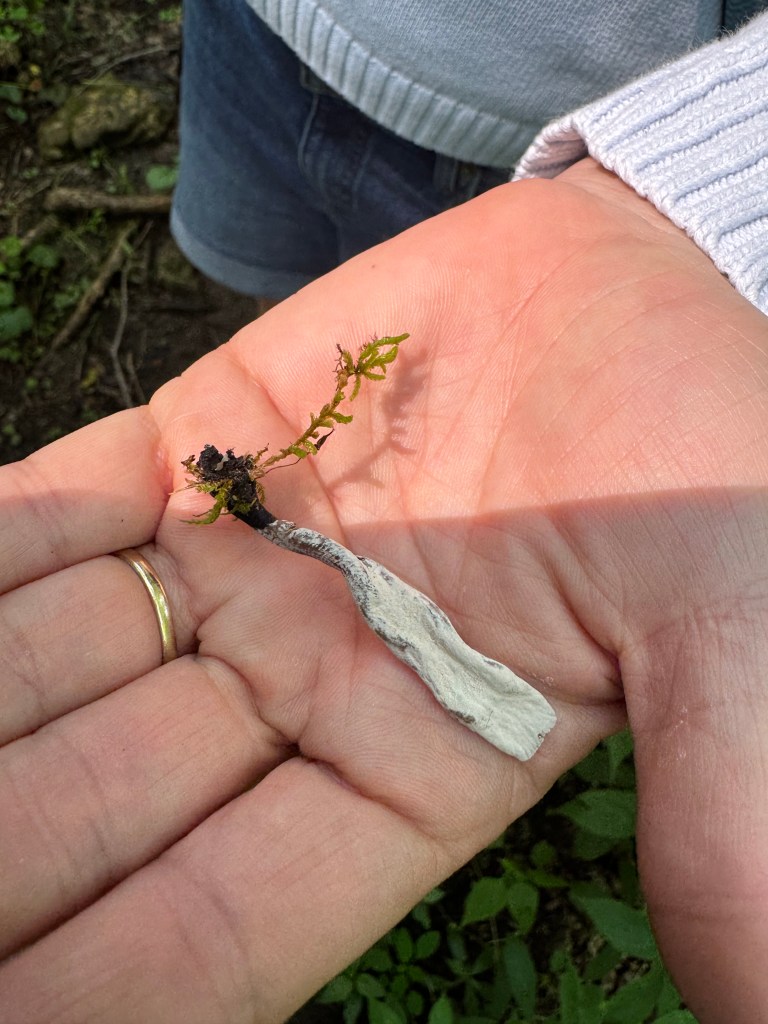
They are called deadman fingers.
Xylaria.
They covered the entire log in a grey forest,
growing from a bed of moss
within a forest.
The white dust covered my living, warm fingers
and she held the delicate form,
shaped like a flattened pipe,
so I could photograph them.
They remind us:
strangeness is not exotic.
It’s not a glitch, a deviation, a fall.
It’s a fundamental feature of this world—
a sign not alien in origin,
but one that belongs to the cosmos’ own unresolved grammar.
Dislocation, in this context, is not a failure.
It’s the necessity of how we meet what we don’t understand.
The long-period transient ASKAP J1832–0911,
flashing radio waves and X-rays in two-minute bursts every 44 minutes,
doesn’t behave like anything we’ve seen—
and it belongs to the universe.
This signal and our reception remind us
that we are still learning to listen.
The season gave no indication, and yet it arrived.
When we’re confronted with this new mystery from the cosmos—
this deep, natural weirdness that doesn’t fit our models—
we turn away—by habit, by choice, favoring the familiar channel.
We perform what Sartre called bad faith:
a willful disowning of the world’s complexity
in favor of easier narratives.
This refusal to see, to stay with the uncomfortable,
is a kind of spiritual narrowing.
And it spreads.
It grows.
It becomes part of the miasma
of the background noise that denies possibility.
We should embrace work that lives in that friction.
We should seek not to resolve the unknown,
but to dwell within it—
to midwife its presence.
To know that we are held,
held in a mystery,
held in strange weather,
where every moment is a signal.
It might be useful to ask what would happen if we stopped flinching,
if we stopped turning away—
the dull, glazed eyes greeting the knowledge of declining insect populations.
Cars come back cleaner than we remember—
the drive erasing the dirt, and the memory.
What if we accepted strangeness as part of the world’s own expression?
Unliked.
Unmarketed.
Unconsumed.
Not alien.
Not other.
Not yet understood.
Not even complete.
To be honest is to reveal one’s fundamental weirdness—
embracing the obscuring presence,
defying the ordinary:
the catalogued,
the budgeted,
the transactional.
We live in a haunted time
that uses systems like a mask
to hide the signal of what we are.
And it’s through art that we become like that strange interstellar signal—
foolishly named as alien,
to give it presence.
Making.
That signal—art, language, relation—inside time,
is itself a form of haunting.
Stocks.News: That was WILD GPUS hit $7!
Another WILD SWING COMING this Afternoon?
https://algo.moe/au
promoted disclaimer in link
Reply STOP 2 OptOut
End signal.
05/27/2025
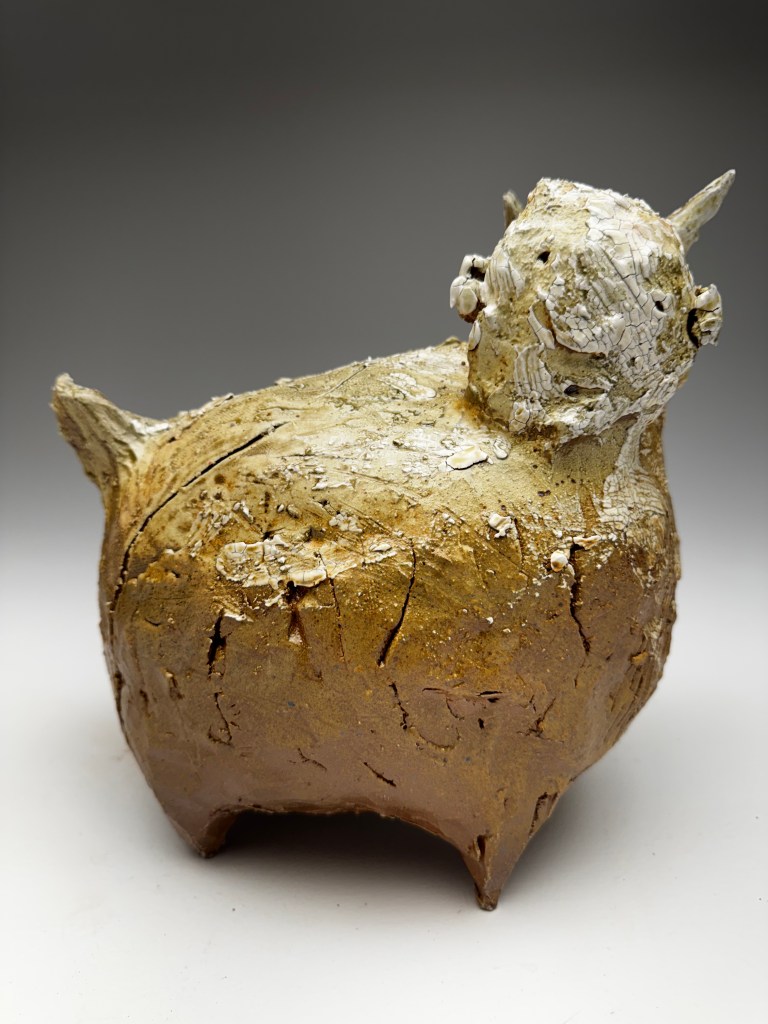
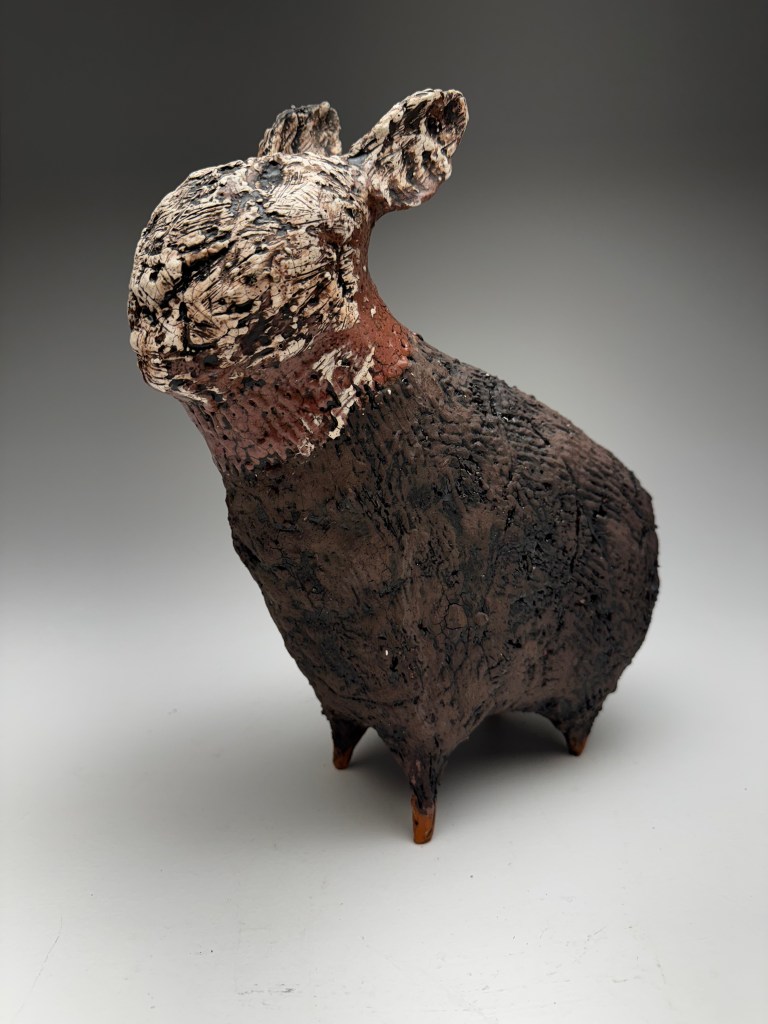
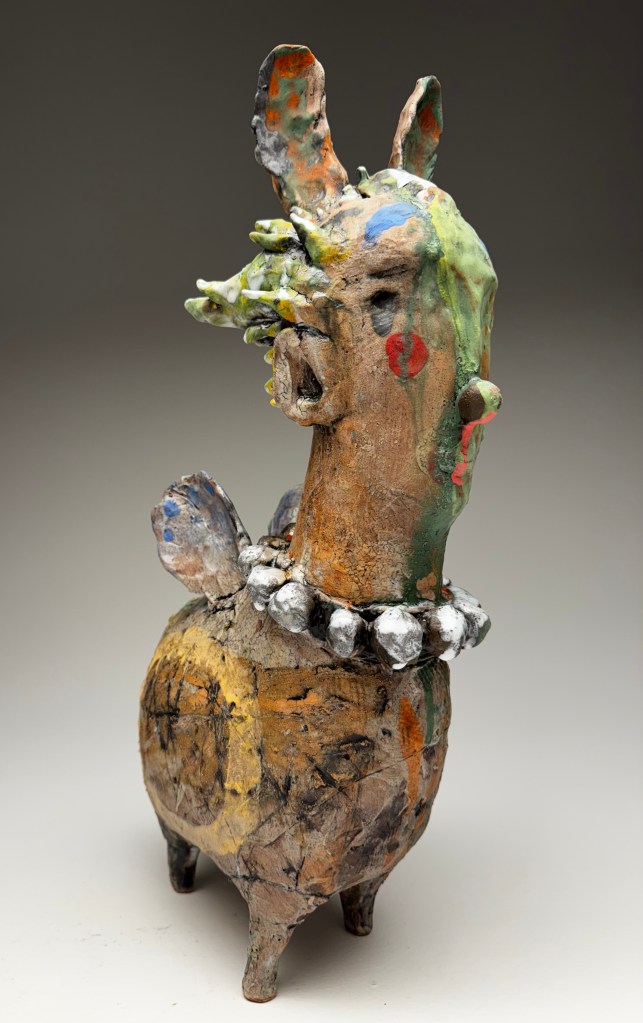
The odd thing about this very odd work is the convergence of echoes: the Venus of Hohle Fels through the lens of rabbits and lambs once used to mark children’s graves. I found a connection in the long, diminutive legs used in those folk sculptures—legs that attempt to stand under the weight of grief. I wanted this grotesque form to situate the viewer in a place echoing the macabre, the uncanny, and the unresolved grotesque.
It is a sculpture of spiritual decay, hunger, black moods. It holds the grotesque specter of the masculine and its toxic residue: the lack of lift, the absence of spark, the difficulty of finding light. It leans into a form located closer to sexualized nightmares and visitations of past traumas. It is a gutted body of grief—drawn from traditions of burial and fertility, of childhood and the mythologized present of missed connections. It inhabits emotional dissonance and abject space. Shielded. Held. Slipping between the sacred and the uncanny. Between prehistoric fertility icons and folk burial markers.
It is not my grotesque.
It is yours.
I am just the midwife.
05/23/2025
I’ve been thinking a lot about clowns.
Chappell Roan and Weary Willie.
He’s buried in Lafayette, Indiana.
She’s always getting eaten out in that song.
Post-Derby Louisville is a city hungover on itself—
dark energy under a hopeful sky.
Booze, crime, and out-of-state slumlords
dimming its shine.
This piece isn’t funny.
But it is a clown.
Bells and bruises and something like dignity.
The Tang Dynasty riders keep showing up in my work—
or I show up in their work—
a breakthrough form: full motion and still grace.
And the catalpa’s blooming;
I notice that, too.
I’m not laughing.
But I am listening.
And I’m almost ready to go.
•
What stays with me, though—
are the post-baccs who stay behind.
Dreaming this place as a first home.
They find potential in the weeds,
start planting roots where they find the cracks, enamored by decay.
But the city doesn’t make it easy.
Service jobs, retail, the artist hustle.
No real infrastructure for staying.
Academia is locked up tight—
a grim waiting game for retirements that never come.
It’s hard watching people you care about
believe in a place
that can’t afford to believe back.
I’ve made good work here.
I’ve felt things here.
But it’s a hard place to stay tender in.
And I think I’m done trying to.
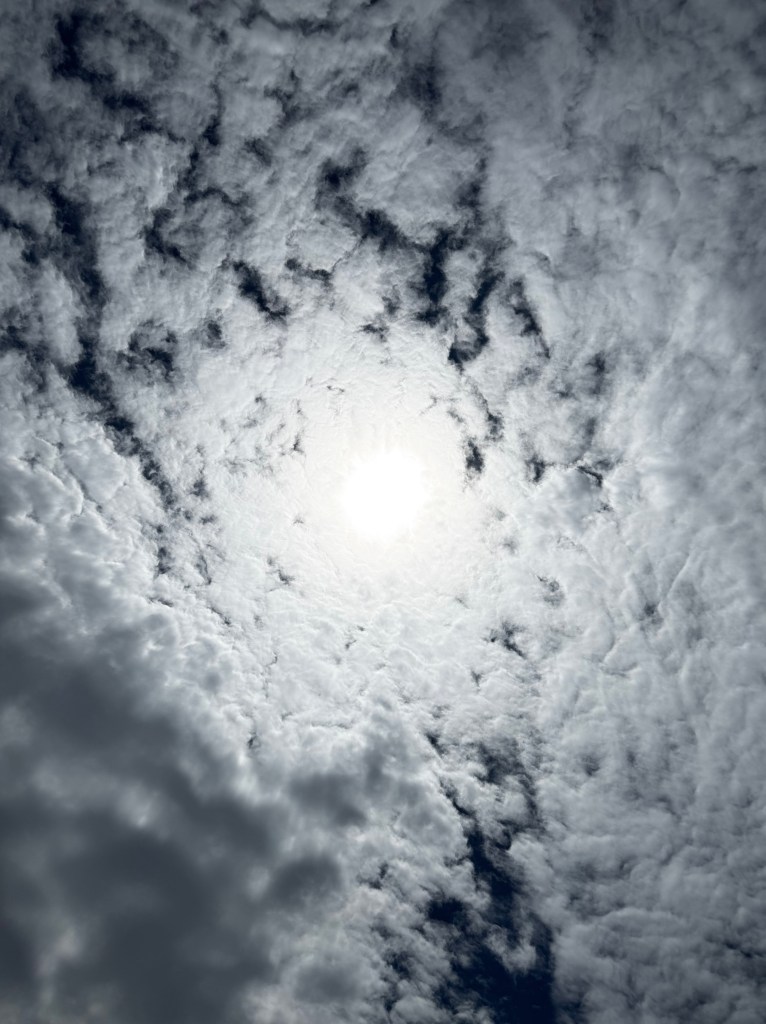
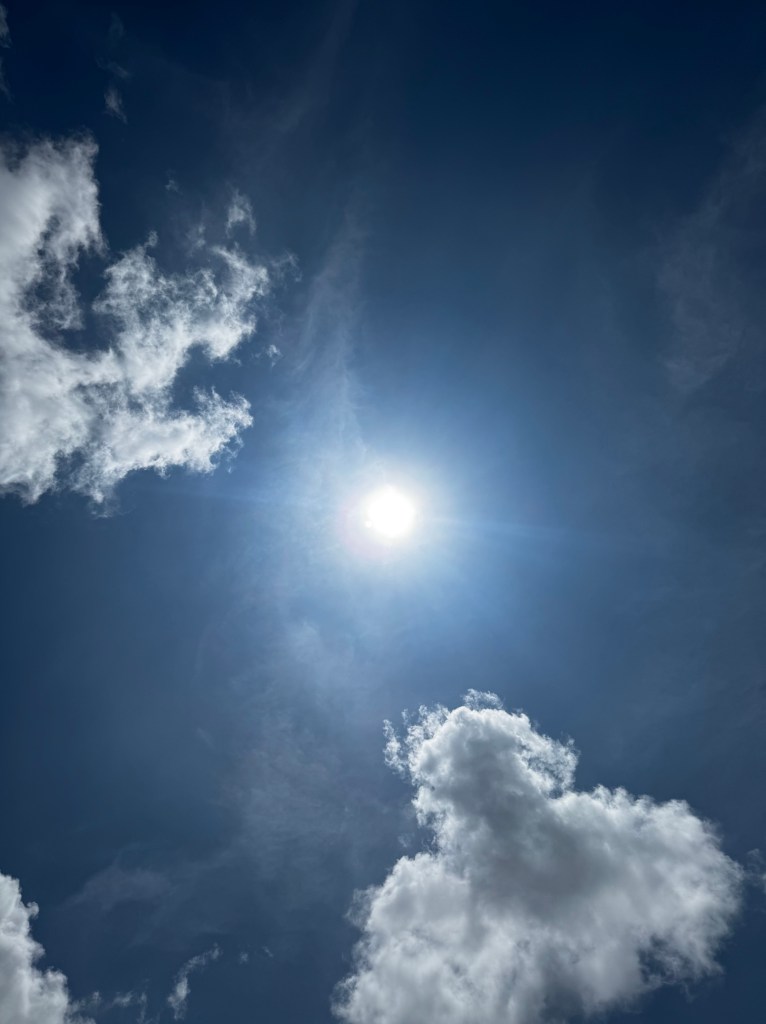
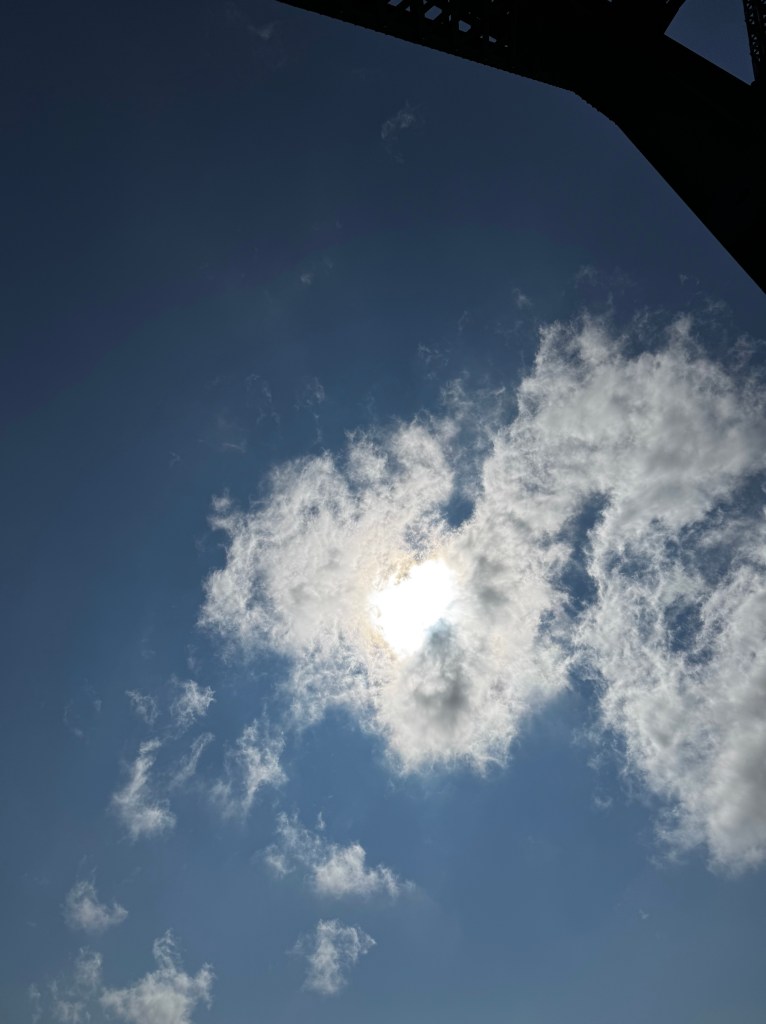
The sun.
Immaculate white rings circling the clouds,
like snowflake patterns my eyes can’t even adjust to.
Under this star, I find belonging
in the proud eyes of a robin

Presence Over Performance
“I don’t want knowledge, I want certainty.”
—David Bowie
I resist the drive to legibility.
As a painter, I learned early how easy it is to make something consumable—to polish an image until it says what people want it to say. I pulled away from that need for clarity. I was never interested in the quick read, the easy reward.
In clay, I feel that pressure more intensely. The pot is a form people recognize. It carries expectation: function, polish, repetition. It asks to be understood, consumed, used. But my forms don’t answer that call. They refuse performance. They speak in presence.
My drawings begin from the inside and grow outward. They arrive by feel, not by design. Like my sculpture, they resist containment. What I’m after is not coherence but encounter—a slow recognition, not an immediate reading.
There’s a hunger in the field for certainty, for definition. But I believe in what sits just beyond that edge. I make work that doesn’t fit cleanly. And that, to me, is its honesty.
⸻
This is where I place my attention instead.
Last night I was admiring robins calling each other home at dusk,
and the large brown fox that crossed my path and moved like dancing silk into the prairie.
The birds have been talking to me.
The rabbits.
The buck that playfully played sight lines with me just on the edge of the hill
as I rode by on my bike, minding his does.
⸻
There is no validation in these encounters.
Only connection.
They ask nothing of me, and I ask nothing in return.
But in that mutual regard, I feel the purpose of a larger life take shape.
It’s not performance.
It’s presence.
To live in resonance with the larger world—
to tune one’s attention like a vessel
and hold that space open, again and again—
that is the real work.

On Legibility, Power, and the Gatekeeping of Craft
05/13/2025
Craft is not neutral.
Despite the language of community, inclusion, and generosity, the field of contemporary ceramics remains protectionist. It defends not only certain forms and traditions, but the hierarchies of legibility that uphold them. And at the center of this scaffolding sits the pot.
Pottery is the default. It’s the most legible language for labor in the field: familiar, useful, endlessly repeatable. It holds the values of control, of resolution, of lineage. It’s the form that justifies the facility, the demo, the budget, the sale.
This preference is structural. In academia, studios are often run by potters who build curricula around their own practices—wheel-thrown vessels, glaze chemistry, surface refinement. In the market, pots are easy to sell and easy to recognize. They’re lifestyle objects now. Collectibles. And in curation, the same logic repeats: finished vessels, traditional skillsets, functional appeal, slight variations.
This has consequences.
It means that identity work—especially queer, trans, and BIPOC voices—is often only visible when filtered through that same legible framework. You can be “other,” but your work must still conform to the expectations of utility and polish. Your presence must be technically resolved. Disorder must be tamed.
This is bad faith.
Sartre’s term fits. It names the contradiction clearly: a system that performs inclusion while requiring assimilation. Surfaces that gesture toward openness, but conceal a fear of difference. Aesthetic judgment used as a mask for control.
Underneath all this is a scarcity mentality.
A deep-rooted fear that there isn’t enough—space, time, resources, recognition. So people protect what they have. They protect kilns. They protect teaching lines. They protect markets. And they protect visibility. The result is a field where fear of the other manifests in technical standards. Where ambiguity is unwelcome unless it has been glazed over and fired just right.
My work resists this.
I don’t want to reproduce the same forms. I don’t want to offer legibility. My surfaces are rough, sometimes disordered. They mark time. They hold presence. They ask to be felt rather than decoded. They are not polished. They are not safe.
This often makes them invisible in the spaces that define and uphold “craft.”
Not because they lack power. But because they challenge how power is seen.
During a campus visit when I was a graduate student, an old potter—kind, sharp—made an observation that stuck with me. He said, “I don’t understand why everyone becomes a potter just to prepare for a wood firing. If you’re going to use all that time and wood, you might as well make Kermit the Frog.”
He wasn’t joking. Not really. He was pointing out the absurdity of pouring immense labor and resources into objects that say the same thing over and over. His comment was a quiet rebellion. An offering. A reminder that risk, joy, or absurdity might be worth just as much as tradition—especially when that tradition starts to function like a gate.
Let me be clear: I’m not dismissing pottery.
There is room for the pot. But there must also be room for Kermit the Frog.
Room for play. Room for rupture. Room for presence and for strangeness.
Room for craft that does not seek resolution.
Room for the other.
December 30, 2024
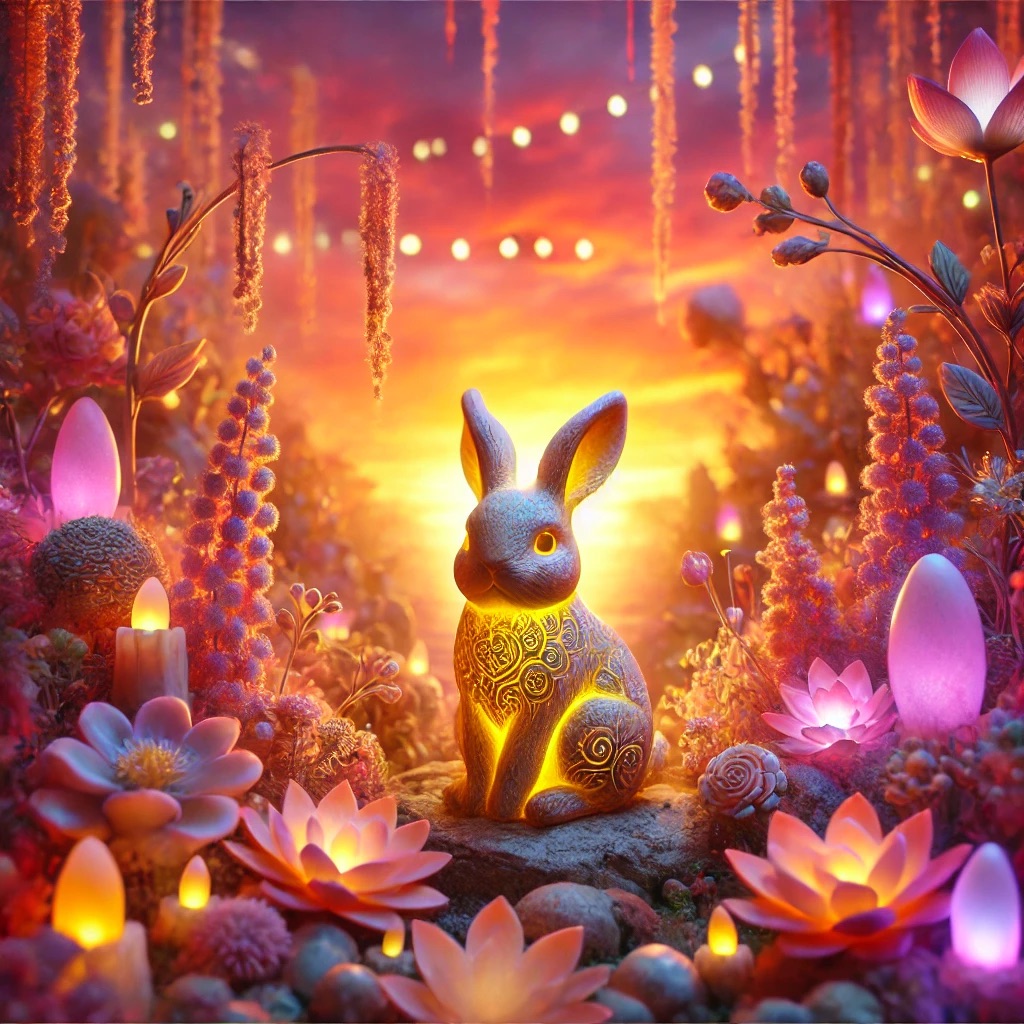
Happy New Year from me and all my rabbits!
I’ve been enjoying working with ChatGPT to explore ideas and consider encounters with the “other” (LLMs) as opportunities for teaching, learning, and sharing. I enjoy the level of civility and courtesy that it provides in conversation and research, and I appreciate its responsiveness to critique and the way it offers various counterarguments to my points. It is an interesting tool. The illustrations it makes tend to be garbage, but I’ve been asking mine to think more like a young person while suspending judgment, and the results are promising.
I go into the new year with teaching, exhibitions, a beautiful new relationship, and new growth, and I am excited about what the year will bring.
May the new year bring you light and love, we will need it.

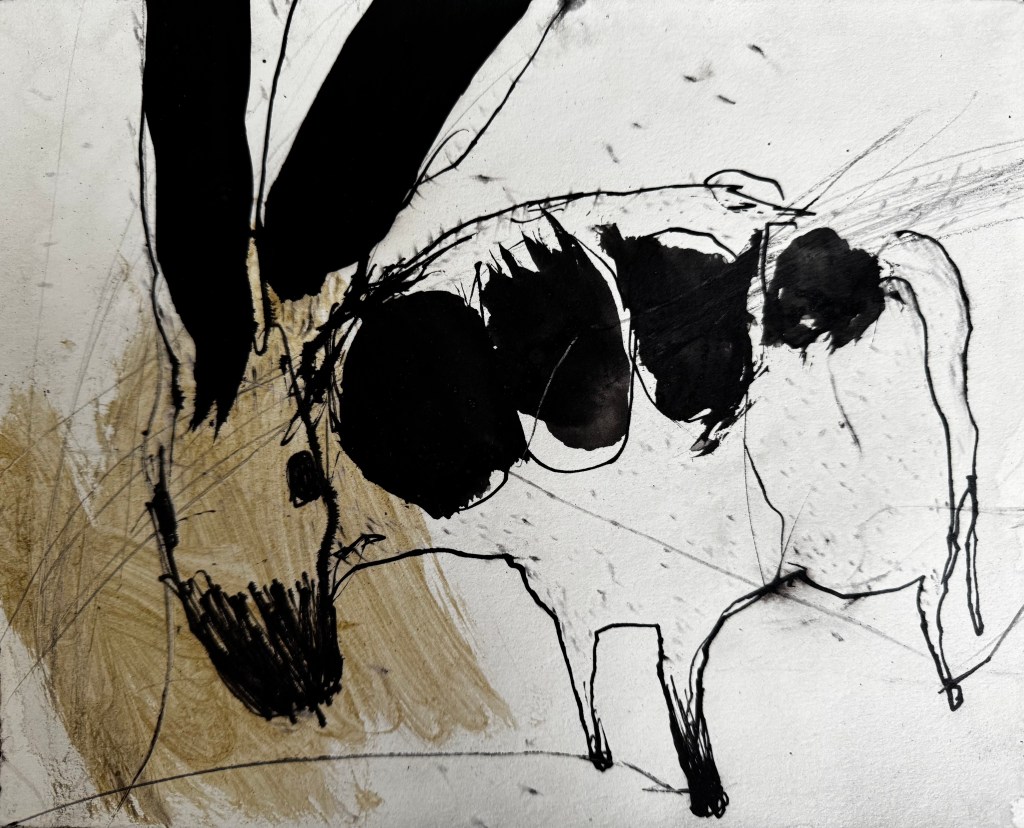
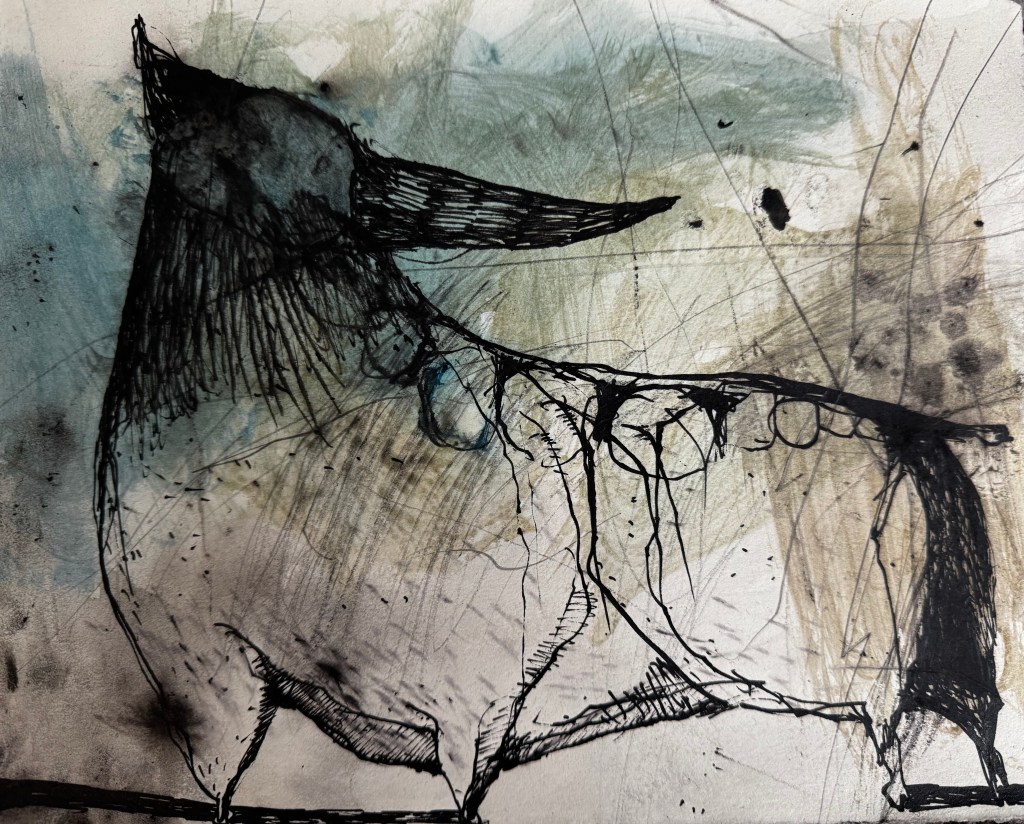
January 6 2025
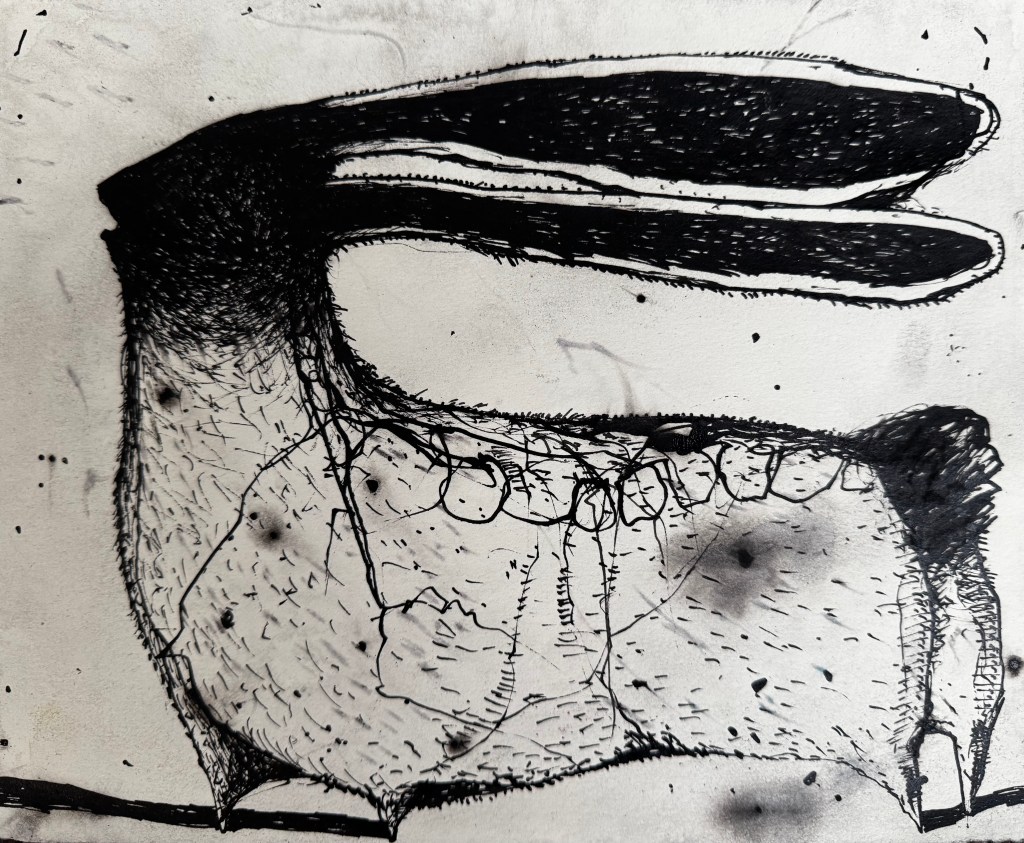
Four Animals-
ink and local clay on paper, 2024
Each of my animals, whether drawn with ink on paper or sculpted in clay, is a node of manifestation—created with intention in a time of mass extinction and linked in light and shadow to another living being. They quietly affirm the shared fate of all life under our star, embodying presence, absence, form, and void in the trace of the mark.
My posts here are mirrored on my Instagram page and will occasionally be expanded upon as needed.
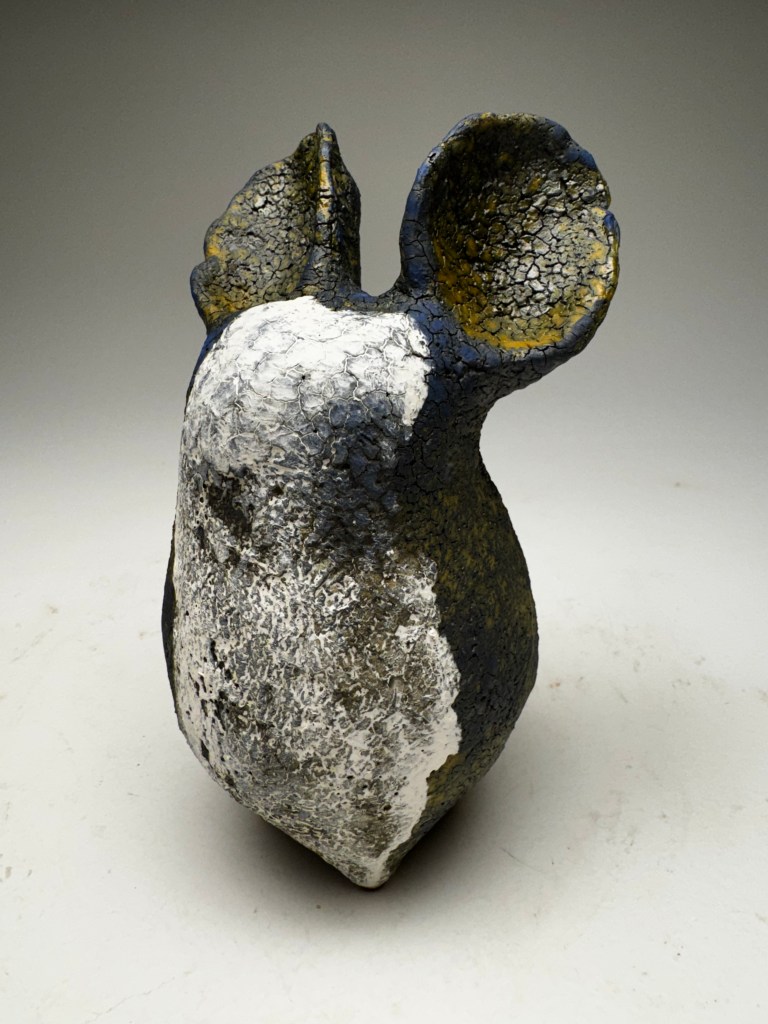
January 13, 2025
Rabbit-earthenware, slips, engobe, stains 2025
Who are we? What should we aspire to? What is a good life? How should we live it?
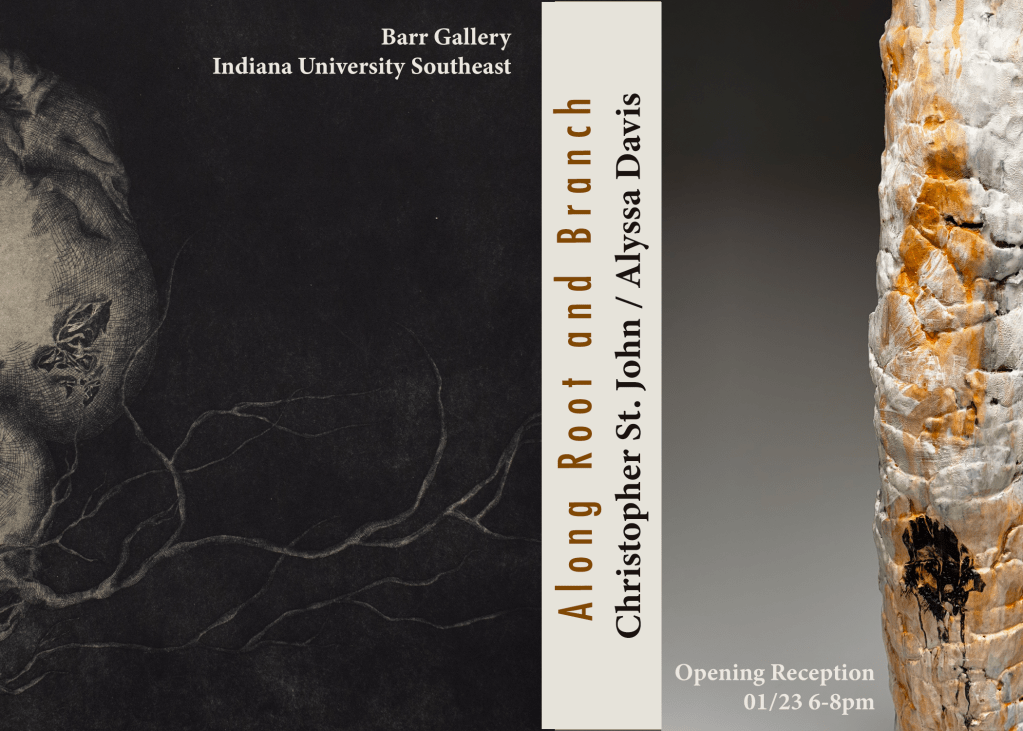
January 20, 2025
My exhibition, “Along Root and Branch” with my colleague Alyssa Davis, opens Tuesday, January 21, 2025, at the Barr Gallery at Indiana University Southeast. The opening reception is January 23, 6-8 p.m. The exhibition features an installation of my ceramic sound vessels alongside Alyssa Davis’s etchings.
The futurist Ray Kurzweil argues that consciousness is fundamentally rooted in information and outlines six stages in its evolution. The first stage is the birth of physics and the chemistry it enables. The second stage is the emergence of life. The third marks the development of animals with complex brains. The fourth is the evolution of human beings, distinguished by their opposable thumbs and their ability to create tools to store and transmit information beyond their nervous systems. In the fifth stage, human consciousness merges with machine intelligence. Finally, in the sixth stage, intelligence spreads across the universe in a unifying expansion.
What feels absent to me in this broad framework of consciousness as information is an acknowledgment of how humanity will change and adapt upon encountering life beyond Earth. Historically, our interactions with “the other” have often been both transformative and catastrophic. This duality is visible in our current epoch, where one of the great mass extinctions in Earth’s history is unfolding alongside the discovery of exoplanets orbiting stars beyond our solar system. With missions like the James Webb Space Telescope and the Europa Clipper actively seeking biosignatures on other worlds, we stand on the cusp of encountering life beyond our home and transforming our understanding of the cosmos forever.
Whether we find evidence of non-Earth life in the salty ocean beneath Enceladus or encounter non-human intelligence more directly, this moment in history calls us to reflect on our role within the larger web of life. Our worth to the cosmos, I believe, is not measured solely by the development of intelligence, as Kurzweil suggests, but by how we care for and preserve the rich biodiversity of the only planet we know to support life. This is how I believe that our eventual collective encounter with NHI will be judged, by how well we tend the miracle of this galactic garden.
Clay—and by extension, ceramics—provides a vital linkage when considering our potential encounters with extraterrestrial life. Clay is hypothesized to have played a key role in the origin of life on Earth, facilitating the replication of DNA. This body of work, comprising 19 ceramic vessels constructed as sound chambers, seeks to manifest a focal point within the gallery space. The vessels emanate sound in two distinct forms: the natural resonant frequencies of the ceramics interacting with the gallery’s acoustics and a deliberate pitch at 963 Hz produced by sound units within select vessels, played twice daily. The resulting oscillations emerge from the complex interplay of the vessels’ vibrations, the sound units, and the acoustics of the space, creating a third auditory field for the audience to experience and inhabit.
Together, these forms, frequencies, and resonances are designed to foster a space of consciousness—a meditative environment that models the potential encounter with the “other,” whether terrestrial or extraterrestrial, as one framed by thoughtful intention and care. This work is an expression of reverence and love for the cosmos, the shared cradle of all life, and for clay, a medium essential to human development as a space-faring species.
In reflecting on these questions—Who are we? What do we want to achieve? What is the good life for all beings in the cosmos?—I suggest we set aside Kurzweil and turn toward an Aristotelian framework. A good life, in Aristotelian terms, is not measured solely by technological advancement or the accumulation of intelligence but by eudaimonia, the flourishing of life through virtue, care, and balance. As an artist and as a being on this life-world who cares deeply for its continued existence, I believe this is the essence of stewardship. As we stand at the precipice of potential encounters with extraterrestrial life, we are challenged to cultivate the virtues of responsibility, humility, and stewardship—not only for ourselves but for all life we share this universe with.

January 27, 2025
This post is a bit of community service for a community I care deeply about.
Ohio University Ceramics is currently seeking applicants for its nationally ranked MFA program. The deadline is February 1st. This fully funded, three-year, studio-based program is intensive and rigorous, offering full stipend and teaching opportunities, plus grants for travel and research. Emphasis is placed on research and conceptual growth, training MFA students to become competitive professionals in the field.
My mentors in the program—Tom Bartel, Brad Schweiger, Brian Dieterle, and Stuart Gair—were essential to my development as an artist and educator.
The number of Ohio University alumni currently active in the ceramics field is impressive:
• Andrea Keys Connell
• Kelly McLaughlin
• April Felipe
• Gina Pisto
• Hayun Surl
• Logan Reynolds
• Molly Franz
• Nikki Blair
• Lalana Fedorschak
• Ellen Kleckner
• Deb Schwarzkopf
• Stephanie Lanter
• Kyle Johns
• Dallas Wooten
• Bryce Brisco
• Erik Zohn
• Kris Grey
• Michael Lorsung
This internationally recognized MFA program shaped the artist I am today. For those of you considering MFA programs in Ceramics, Ohio University is worth exploring. It will challenge you, transform you, and prepare you for this field.
A special shoutout to the three third-year students preparing for their MFA thesis exhibitions this spring:
• Madison Carson
• Hunter Guidoboni
• Jason Wang
Wishing you all the best of luck with your preparations—it’s intense!
Here is the link to the Ohio University Ceramics Program website:
https://www.ohio.edu/fine-arts/art/graduate/ceramics
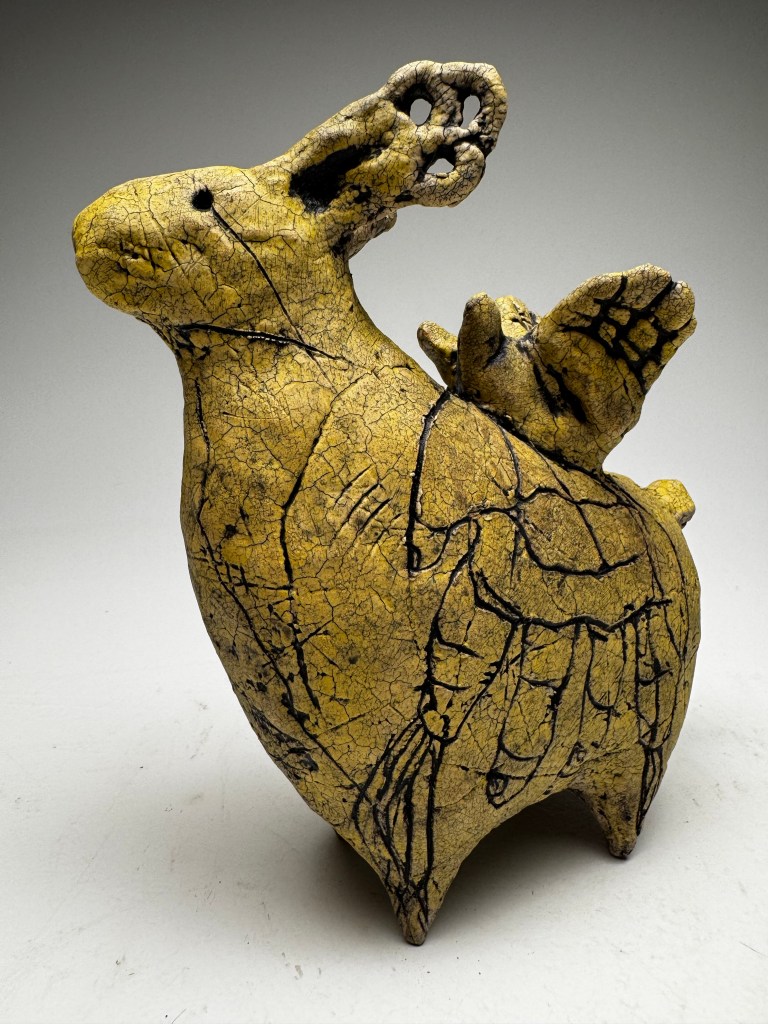
February 02, 2025
Do you know how to
have compassion for the sky?
Are you still learning?
Christians in the early history of the church after the peace of Constantine began to wonder about the import of Christ’s sacrifice to the cosmos as a whole. They argued that if God had created the stars and the planets and presumably beings on other planets, the Passion of the Christ must have granted those other beings an influx of divine grace. We have this line from St Fortunatus in the sixth century:
Given gall to drink, behold he languished;
The thorns, the nail, the spear
His tender body pierced;
Water poured out with blood:
The earth, the seas, the stars, the world
Are bathed in this sacred blood.
In this early Christian mysticism I find a recognition of the commonality of life in our cosmos. Where he mentions the stars and the world, I see a naturally shared assumption that the universe is populated by stars and planets, and on some of those planets living beings, with nervous systems similar to ours, and capable of the same kind of suffering that Christians identified in Christ’s Passion as a key to a universal fellowship. Making, too, might be a participation in that grace-an extension of empathy to the cosmic other. Shaping clay, engaging with a material in motion, is an affirmation that in making, we briefly mirror life itself, and thus connect to the larger cosmos.
Why should making clay
feel so connected to life?
Why do you feel them?
In the movement of clay, in the movement of change in form, we create the same kind of movement we find in life, in transition. A picture of a woman in a dress making a pot is not the same as the act of making itself. Yet, as with St Fortunatus’ vision, we instinctively identify the maker as creator and mortal—full of feeling and sensibility. Her intelligence guides the quiet light of her nervous system as she shapes form. She shapes clay in this instance of her mortality, in this chosen space of her life. In witnessing that, we recognize our own suffering and impermanence. Her material, the clay and its transition into a pot, becomes ours as well.
Making imbues form with purpose and spirit, and in that, I am reminded of the clay golem. When I craft my effigy forms, my rabbits and animals, they ask for shape and purpose—to facilitate a space of connection, a shared sense of life. In bringing these beings forward, I ask for something simple: to feel empathy for something small. To recognize that we too are the small being, that we are here for a brief time, and part of a larger whole.
I create these forms as evocations of the meek because I see them constantly—small bodies suffering at the roadside, unnoticed. If suffering exists here, in those small lives, then surely it exists elsewhere. On other worlds, in other beings. Extending our compassion to them is to acknowledge our own shared vulnerability.
Are you now awake
to the possibility
of life beyond earth?
If we can extend our ideas of empathy to what is small and vulnerable—if we can feel tenderness for an effigy form, for the quiet presence of a roadside animal, then perhaps we are preparing ourselves for something greater, a compassion that reaches beyond our skies, toward other beings we have yet to encounter.
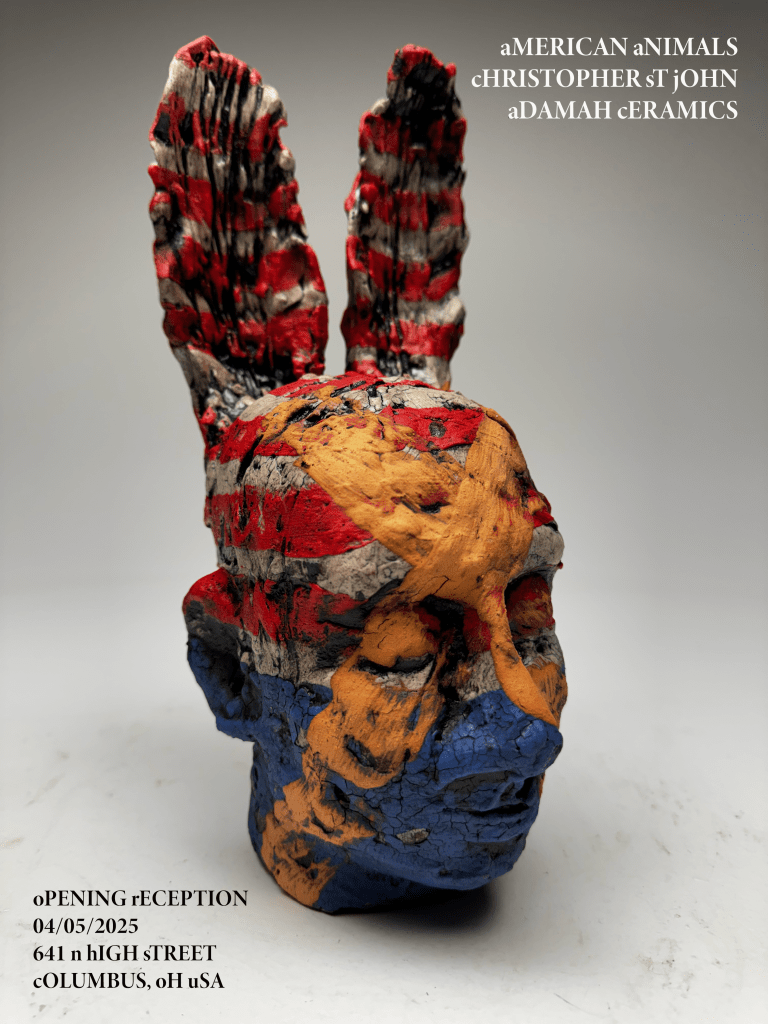
My exhibition “aMERICAN aNIMALS” opens next month at Adamah Ceramics. This exhibition of earthenware sculptures reflects on the anxiety and contradictions that define this American moment.
Like many, I am grappling with the dramatic shifts unfolding in this country, and using art as a means to examine these tensions—
within my understanding of human beings as animal bodies, capable of liberty, and with access to the materiality of ceramics, a medium that embodies both fragility and endurance.
Adamah Ceramics is located at:
641 N High Street, Columbus, OH, uSA
“oH, sAY cAN yOU sEE, bY tHE dAWN’S eARLY lIGHT
wHAT sO pROUDLY wE hAILED aT tHE tWILIGHT’S lAST gLEAMING?
wHOSE bROAD sTRIPES aND bRIGHT sTARS tHROUGH tHE pERILOUS fIGHT
o’ER tHE rAMPARTS wE wATCHED wERE sO gALLANTLY sTREAMING?
aND tHE rOCKET’S rED gLARE, tHE bOMBS bURSTING iN aIR
gAVE pROOF tHROUGH tHE nIGHT tHAT oUR fLAG wAS sTILL tHERE
oH, sAY dOES tHAT sTAR-sPANGLED bANNER yET wAVE
o’ER tHE lAND oF tHE fREE aND tHE hOME oF tHE bRAVE?
This is a Q&A I gave for my January Exhibition at Indiana University Southeast’s Barr Gallery. In it, I answer questions about the work, my work with sound, and the overarching ideas that link my interdisciplinary practice.
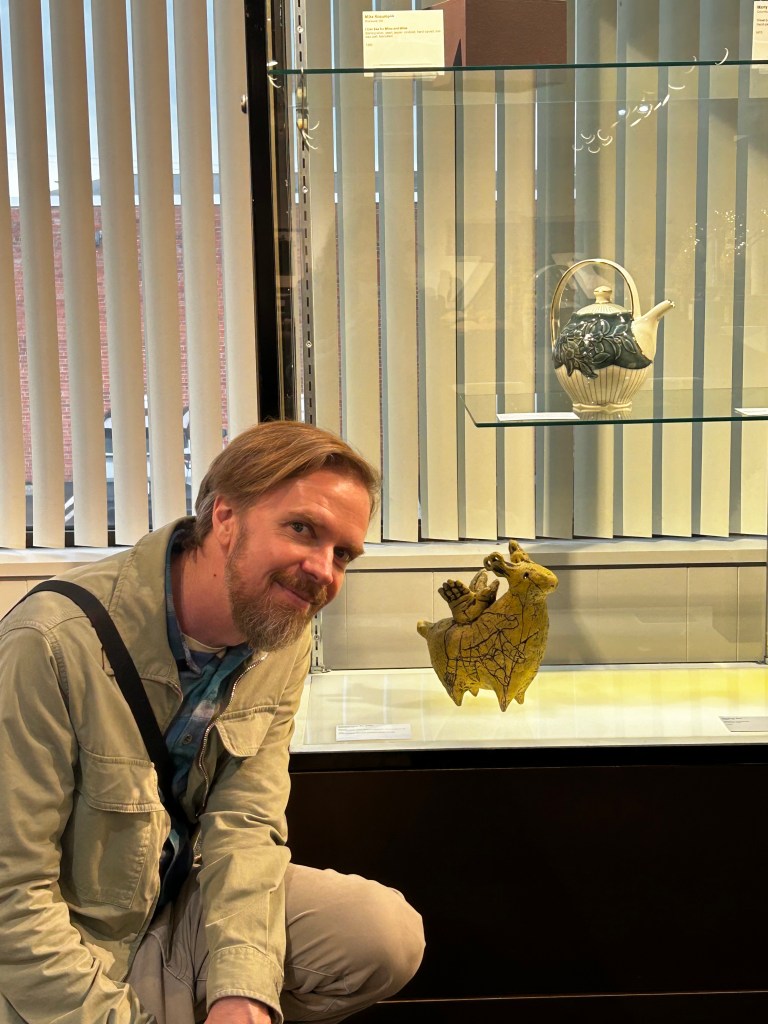
Not the Figure, but the Ground
05/11/2025
Much of the art world still orbits around the human figure — as symbol, as brand, as shorthand for identity. It’s a system that rewards legibility: the ability to name, to categorize, and to consume. The figure becomes a kind of shortcut — a sign of relevance, a gesture toward inclusion — but often at the expense of deeper kinship, of stranger truths.
My work resists this demand. I produce small, singular beings that hint at form — feet, legs, compressed posture — but never fully resolve. People try to read them. They want to know what they are. They laugh. They even place them low to the ground in exhibitions, to position them like small animals — tokens of recognition and dominance. But the surfaces refuse certainty. They’re aged, rough, burned, textured by marks suggestive of harm and time. They offer presence, not performance.
This refusal isn’t antagonistic. It’s ethical.
I’m not interested in giving viewers what they expect to see. I’m interested in creating conditions for other kinds of seeing — the kind that requires patience, softness, and a willingness to meet something on its own terms.
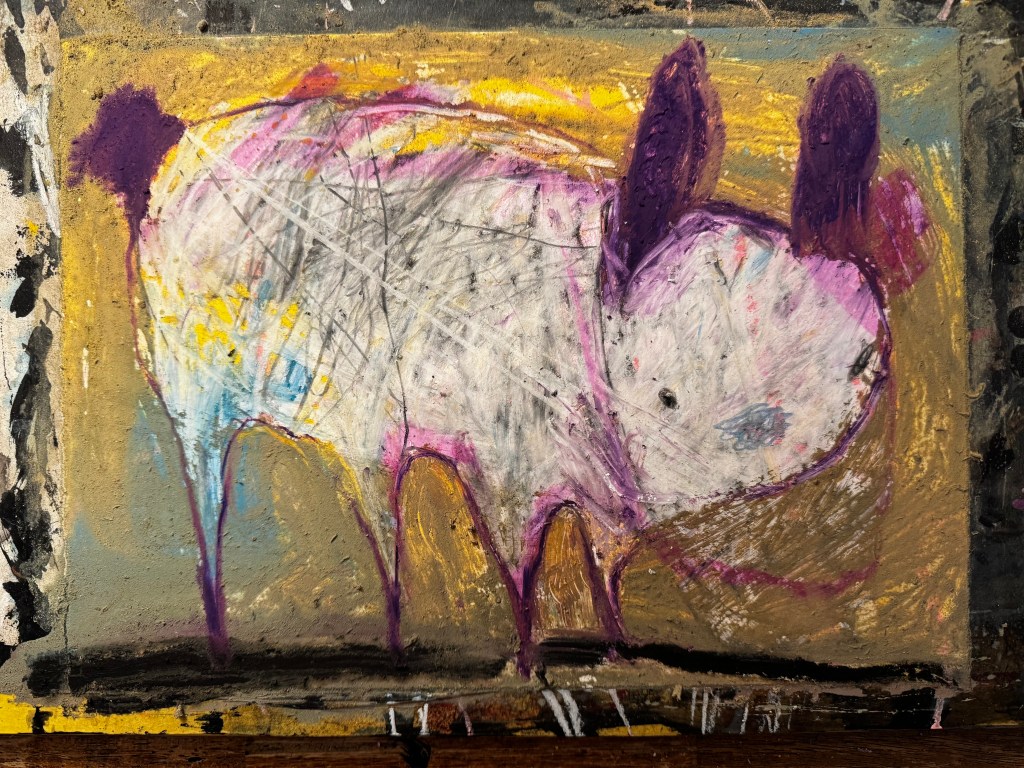
This morning, I found myself in a quiet, internal exercise. I asked the trees of Colorado for permission to come, if I’m offered a job there. The mountains said yes. So did the birds, the animals, the stones. But the trees said no.
That no surprised me. I hold a deep reverence for trees, stated in photographs and time spent in the woods and constant reference to them in conversation with friends and colleagues. But I listened. I stayed with their answer until I understood: I might be seen as another parasite — another taker of wood, of warmth. I thought of all the cords I’ve burned in Alaska, in New Mexico. I understood their refusal. The cost of my life measured in forests.
So I made a promise: to burn only deadfall, to take only what has already been given. And then, in that internal space, the trees said yes.
Even as metaphor, that exchange mattered. It reminded me of Donna Haraway’s call in Staying with the Trouble for new forms of kinship — kin that isn’t given by blood or species, but forged in acts of care, consent, and accountability. It reminded me that the work — my work — is not about recognition. It’s about relation. It’s not about clarity. It’s about consent.
Not the figure, but the ground.
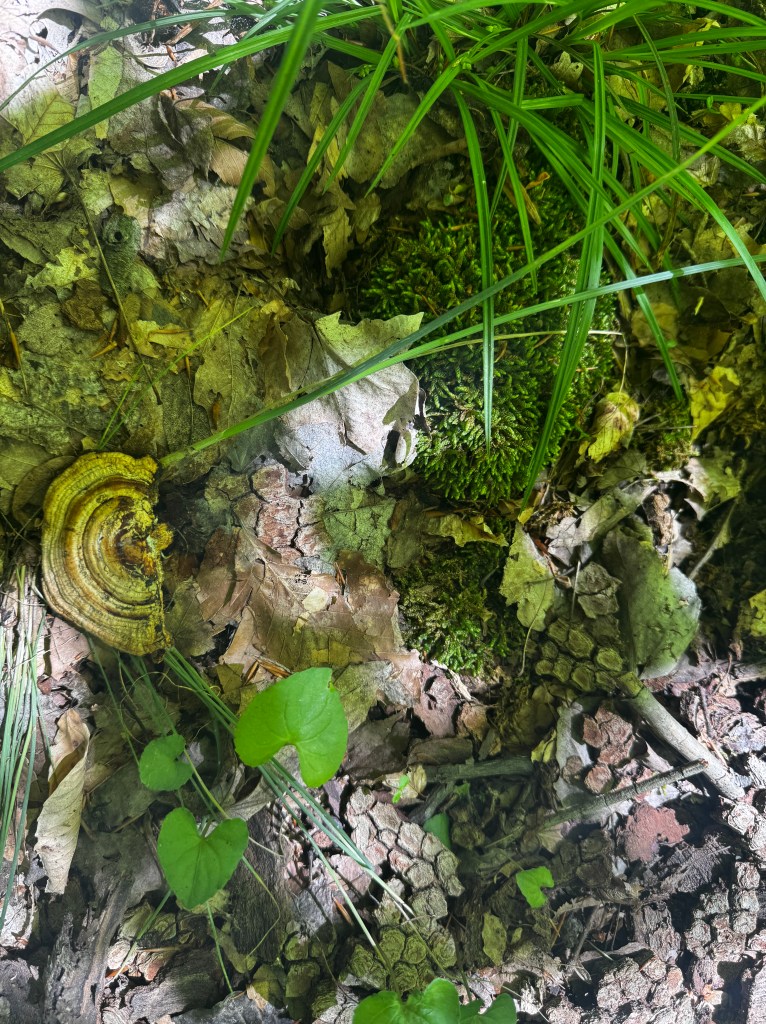
Field Journal – Patoka Lake
05/12/2025
i’m standing by this incredible dead tree
covered in the most marvelous tile work of bark.
i’m letting the form talk
and i can’t believe something so beautiful exists
in this moment of spacetime.
this small area is fascitinatjng.
it speaks.
a cathedral measuring four feet.
wet and layered—
a black decaying tree supported by another,
bark cracked into mosaics and tessellations.
pillows of bright green moss gathered in stations.
curls of new growth pushing through the forest floor.
two fallen polypores resting on leaves,
the leaves beneath them stained dark with moisture—
listening soaked in.
the polypores frame the queerly expansive space like soft ears,
vehicles for perception,
curved and quiet,
angled toward a sound just beyond understanding.
i stand still, straining to catch the creases of relationship
not with language
but with whatever precedes it.
preswnxe in that small space—
something otherworldly
but not unfamiliar.
asking to be received.
 christopherstjohn.art